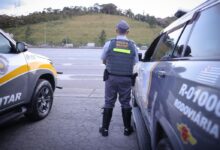
Um soldado da ROCAM, Ronda Ostensiva com Apoio de Motos, morreu ao reagir a um assalto na(altura do número 172 da Rua Aviadora Anésia Pinheiro Machado, no Conjunto Habitacional Parque Valo Velho,) região do Capão Redondo, Zona Sul da Capital paulista.
André Luiz Roberto estava de férias e à paisana quando foi atacado na noite desta terça-feira(29). Ele chegava em casa de moto, acompanhado da mulher dele, quando foi cercado por cinco bandidos, que chegaram em outras três motocicletas.
A esposa do policial já havia passado pelo portão quando ele, pressentindo que seria atacado, sacou a pistola que carregava consigo e passou a trocar tiros com os criminosos.
No confronto, o soldado acabou sendo atingido por vários disparos, um deles no tórax.
O militar ainda foi socorrido pelo Corpo de Bombeiros e encaminhado ao Hospital Municipal do Campo Limpo, mas ele não resistiu aos ferimentos.
Após o crime, os bandidos fugiram e ainda roubaram o carro de um motorista nas proximidades.
Dois outros Pms da ROCAM chegaram a perseguir os assaltantes, mas, na correria, eles sofreram uma queda e também precisaram ser socorridos. Os dois passam bem.
Pouco depois, o veículo roubado pelos assaltantes foi abandonado no interior de uma favela na região do Jardim Ângela com uma arma dentro.
Pms fizeram uma busca na região, quando teriam localizado e trocado tiros com dois dos bandidos, mas não há informações sobre suspeitos presos.
O soldado André Luiz tinha 25 anos e atuava havia apenas dois meses no 3° Batalhão de Choque.
Uma equipe do DHPP, o Departamento de Homicídios e Proteção à Pessoa, vai investigar o crime.
*Com informações do repórter Paulo Édson Fiore, da rádio Jovem Pan.
The cf_use_ob cookie informs Cloudflare to fetch the requested resource from the Always Online cache on the designated port. Applicable values are: 0, 80, and 443. The cf_ob_info and cf_use_ob cookies are persistent cookies that expire after 30 seconds.
session
__cfwaitingroom
The __cfwaitingroom cookie is only used to track visitors that access a waiting room enabled host and path combination for a zone. Visitors using a browser that does not accept cookies cannot visit the host and path combination while the waiting room is active.
session
cf_chl_rc_i
These cookies are for internal use which allows Cloudflare to identify production issues on clients.
session
cf_chl_rc_ni
These cookies are for internal use which allows Cloudflare to identify production issues on clients.
session
cf_chl_rc_m
These cookies are for internal use which allows Cloudflare to identify production issues on clients.
session
__cfruid
Used by the content network, Cloudflare, to identify trusted web traffic.
session
__cf_bm
Cloudflare's bot products identify and mitigate automated traffic to protect your site from bad bots. Cloudflare places the __cf_bm cookie on End User devices that access Customer sites that are protected by Bot Management or Bot Fight Mode. The __cf_bm cookie is necessary for the proper functioning of these bot solutions.
session
__cflb
When enabling session affinity with Cloudflare Load Balancer, Cloudflare sets a __cflb cookie with a unique value on the first response to the requesting client. Cloudflare routes future requests to the same origin, optimizing network resource usage. In the event of a failover, Cloudflare sets a new __cflb cookie to direct future requests to the failover pool.
session
_cfuvid
The _cfuvid cookie is only set when a site uses this option in a Rate Limiting Rule, and is only used to allow the Cloudflare WAF to distinguish individual users who share the same IP address.
session
cf_clearance
Whether a CAPTCHA or Javascript challenge has been solved.
session
__cfseq
Sequence rules uses cookies to track the order of requests a user has made and the time between requests and makes them available via Cloudflare Rules. This allows you to write rules that match valid or invalid sequences. The specific cookies used to validate sequences are called sequence cookies.
session
cf_ob_info
The cf_ob_info cookie provides information on: The HTTP Status Code returned by the origin web server. The Ray ID of the original failed request. The data center serving the traffic
session
Google's current Sign in with Google client library. It renders the Google sign-in button, or the One Tap prompt, so visitors can log in to your site with their Google account. It replaces the older Google Sign-In platform library.
Set on your own domain by the Sign in with Google client library. Records whether the visitor has dismissed the One Tap sign-in prompt and for how long it should stay hidden, plus the time the library last loaded and a browsing session id used for the same purpose. Sites that pass a custom state_cookie_name will see that name instead.
180 days
g_csrf_token
Set on your own domain by the Sign in with Google client library and submitted together with the sign-in credential, so your site can confirm the sign-in came from its own page and not from a forged cross-site request.